


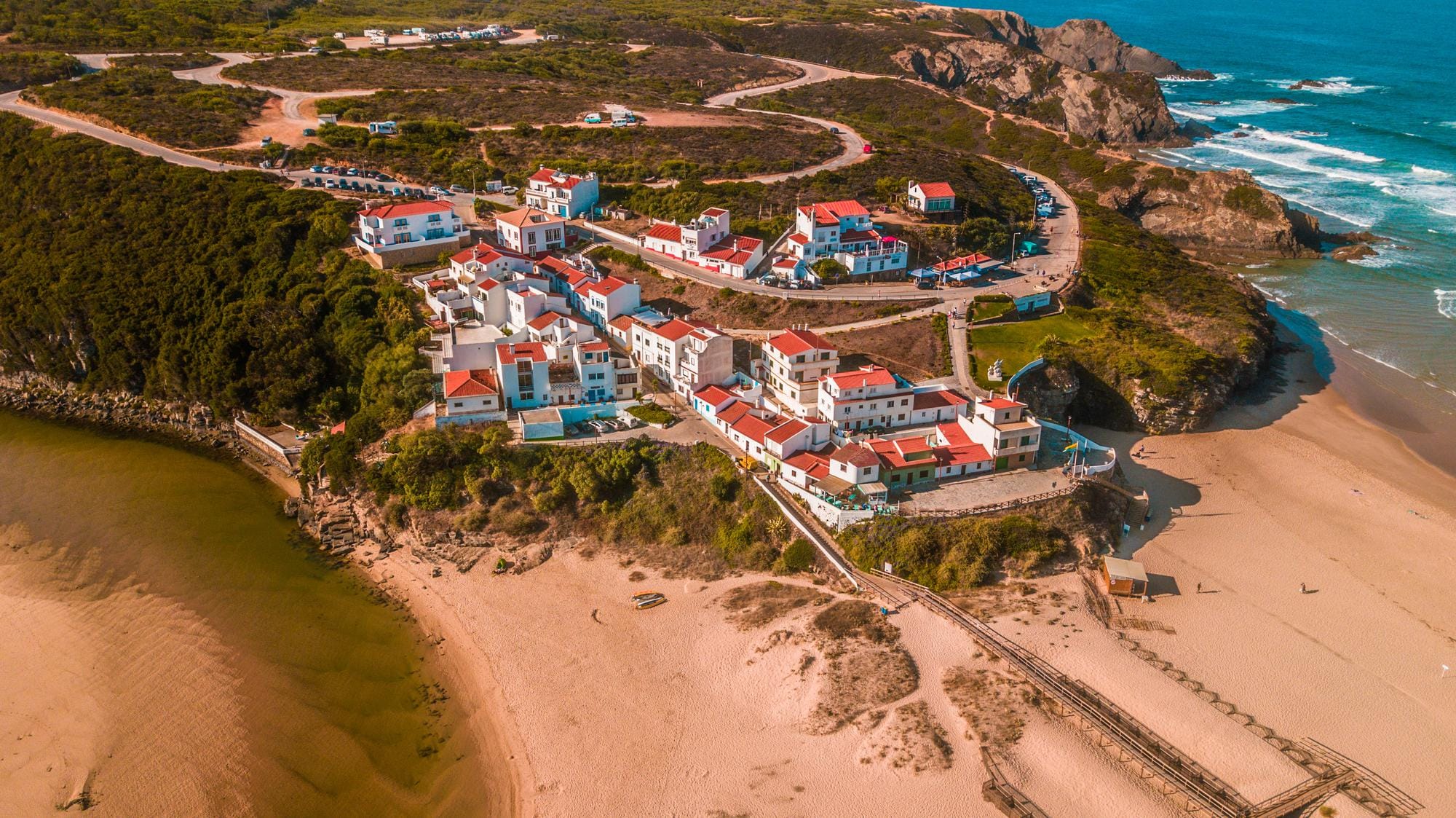
Those who are considering moving to Portugal almost always end up looking to the Algarve. Sun for much of the year, world-class beaches, an international airport and a large and established foreign community make the region one of the most sought after in the country — both to live and to have a holiday home.
But the Algarve is not just one thing. Between the wild coast of Aljezur and the quiet village of Tavira there is about 150 km of coastline, and the differences between regions are great: in pace, price, type of house and life that is led outside the high season.
In this guide we go through the main areas of the Algarve, to help you understand which one can be yours.
How the Algarve is divided
The first division is the coast:
- West of Faro — cliffs, caves and jagged beaches, from Sagres to Albufeira.
- Leeward of East — extensive sandy beaches, barrier islands and the Ria Formosa, up to the border with Spain.
The second is the distance from the sea: the coast, where most of life and tourism is; the barrocal, a strip of hills with almond trees, carob trees and quiet villages; and the mountains, from Monchique to Caldeirão, greener, more secluded and affordable in price.
Costa Vicentina: Aljezur, Sagres and Vila do Bispo
The west coast is the wildest Algarve. Integrated in the Southwest Alentejo and Costa Vicentina Natural Park, it has Atlantic beaches, waves sought after by surfers from all over the world and very strict building rules, which keep the landscape almost intact.
For whom: those who value nature, surf and tranquility above all else — and accept being further away from hospitals and services. The sea here is colder and windier than in the rest of the Algarve.
Lagos, Portimão and Lagoa
Lagos combines a walled historic center, marina and some of the most photographed beaches in the country, such as Ponta da Piedade. It has a large international community, several international schools in the Luz area and life all year round.
Portimão is the largest city in the Barlavento, with a hospital, commerce and services, and Praia da Rocha as a seafront. Next door, Alvor and Ferragudo maintain a fishing village atmosphere, and the municipality of Lagoa, with Carvoeiro, joins cliffs, golf and villas with sea views.
For who: families and remote professionals who want the cliff coast without giving up a functional city nearby.
Albufeira and the “Golden Triangle”
Albufeira is the largest tourist hub in the region, lively and with something for all budgets — but very marked by the high season.
To the east, between Vilamoura, Vale do Lobo and Quinta do Lago, is the so-called “Golden Triangle”, where golf courses, resorts and the most expensive real estate in the Algarve are concentrated. Almancil and the city of Loulé, with its market and local life all year round, complete this area, which also has the highest concentration of international schools in the region.
For whom: those looking for golf, marina, condominium security and high-end services, 15–20 minutes from the airport.
Faro and Olhão
Faro is the capital of the district and the most “practical” city in the Algarve: airport, central hospital, university, commerce and services all year round. The historic center, within walls, opens onto the Ria Formosa.
Olhão, a few minutes away, has its own architecture — cubic houses of roof terrace, of North African influence —, a famous market and access by boat to the islands of Culatra and Armona. It has been one of the areas that has been most valued in recent years.
For whom: who wants to live all year round in a real city, with everything at hand, and not just in a holiday resort.
Tavira and the Sotavento
Tavira is, for many, the most beautiful village in the Algarve: historic houses, treasure roofs, churches and the bridge over the Gilão River. The beaches are on the islands of the Ria Formosa, such as Ilha de Tavira and Praia do Barril.
Further east, Cacela Velha, Castro Marim and Vila Real de Santo António offer a calmer Algarve, with the Guadiana River and Spain right next door — Seville is about a two-hour drive away.
For whom: retirees, families and those who prefer authenticity and quiet to animation, with warmer and calmer seas than in the Barlavento.
Barrocal and mountains: Silves, São Brás, Loulé interior and Monchique
15 or 20 minutes from the coast, the interior of the Algarve changes completely. Silves, with its castle, São Brás de Alportel, the inland villages of Loulé and the Monchique mountains offer more space, farms with land and more affordable prices than on the coast.
For whom: those who want a bigger house, with a garden or swimming pool, and are willing to drive to the beach. This is also where many foreigners recover old rural houses.
Faro Airport: the Algarve connected to Europe
One of the great assets of the region is Faro Airport, which in 2025 exceeded 10 million passengers for the first time, with connections to more than 70 destinations in about 20 countries.
- Europe: the vast majority of flights are direct connections to European cities, with the United Kingdom as the main market — from London to Manchester, Bristol and many other cities — and frequent connections to Ireland, Germany, the Netherlands, France, Poland and the Nordic countries, operated mainly by companies such as Ryanair, easyJet, Jet2 and Wizz Air.
- North America: seasonal flights to Toronto and, since 2025, a United Airlines connection to New York (Newark) during the summer.
- National: connection to Funchal, Madeira, throughout the year.
For those coming from Brazil, there are still no direct flights to Faro: the connection is usually made through Lisbon, about 2h45 by car or 3 hours by train, or by another European airport.
Holiday homes and summer rentals
The Algarve has been the holiday destination for many Portuguese and foreign families for decades. Many have their holiday home here — used in summer, Easter and on long weekends — and it is common for it to pass from generation to generation.
Other families rent a house for the summer every year in the same area. This is why short-term rentals are so important in the region: many owners combine their own use in a few weeks with renting the rest of the summer, helping to pay the costs of the house.
For those considering buying, this is a decision that should be made early, because it influences the project: a house designed for rent needs more resistant materials, closed storage for the owner and a decoration that is easy to maintain. Also pay attention to the rules of local accommodation, which require registration and vary depending on the municipality.
Schools, hospitals and services
- Hospitals: the main public hospitals are in Faro and Portimão, with smaller units in other municipalities. There are also several private hospitals and clinics, especially between Faro, Albufeira and Portimão.
- International schools: they are concentrated in two areas — between Loulé, Almancil and Vilamoura and between Lagoa and Lagos — with mainly British curricula, as well as German and Dutch options in Silves and an international school in Aljezur, Tavira and Olhão.
- Higher education: the University of Algarve, in Faro.
Rule of thumb: the closer to the Faro–Loulé–Portimão axis, the easier it is to have everything at hand. At the ends — Costa Vicentina, mountains and the far east — services are scarcer.
Living the Algarve all year round
This is the advice we give the most to those who are deciding: visit the area in January, not just in August. Some very touristy locations are quite empty in winter, with restaurants and shops closed. Others — such as Faro, Loulé, Lagos, Tavira or Olhão — maintain local life throughout the year.
The Algarve winter is mild, but houses are not always prepared for it: many were built with summer in mind, with little insulation and no heating. It is a point to consider in any purchase or remodeling.
Algarve architecture in a current project
The traditional architecture of the Algarve — whitewashed walls, straw tiles, roof terraces in Olhão, treasure roofs in Tavira and the well-known lacy chimneys — was born to deal with the heat. A good interior design today takes advantage of this logic: shading of the most exposed facades, cross ventilation, materials that do not heat up to the touch and, by the sea, hardware and window frames resistant to salinity.
Whether you are restoring a traditional home, preparing a holiday home to rent or decorating a new property by the coast, CW Arquitetura follows the project from start to finish, including the purchase of furniture and the coordination of the work. Learn more about what we do at CW Arquitetura.
Are you thinking of moving to the Algarve or having your holiday home here? Talk to CW Arquitetura and tell us about your project. Talk to CW Arquitetura.