


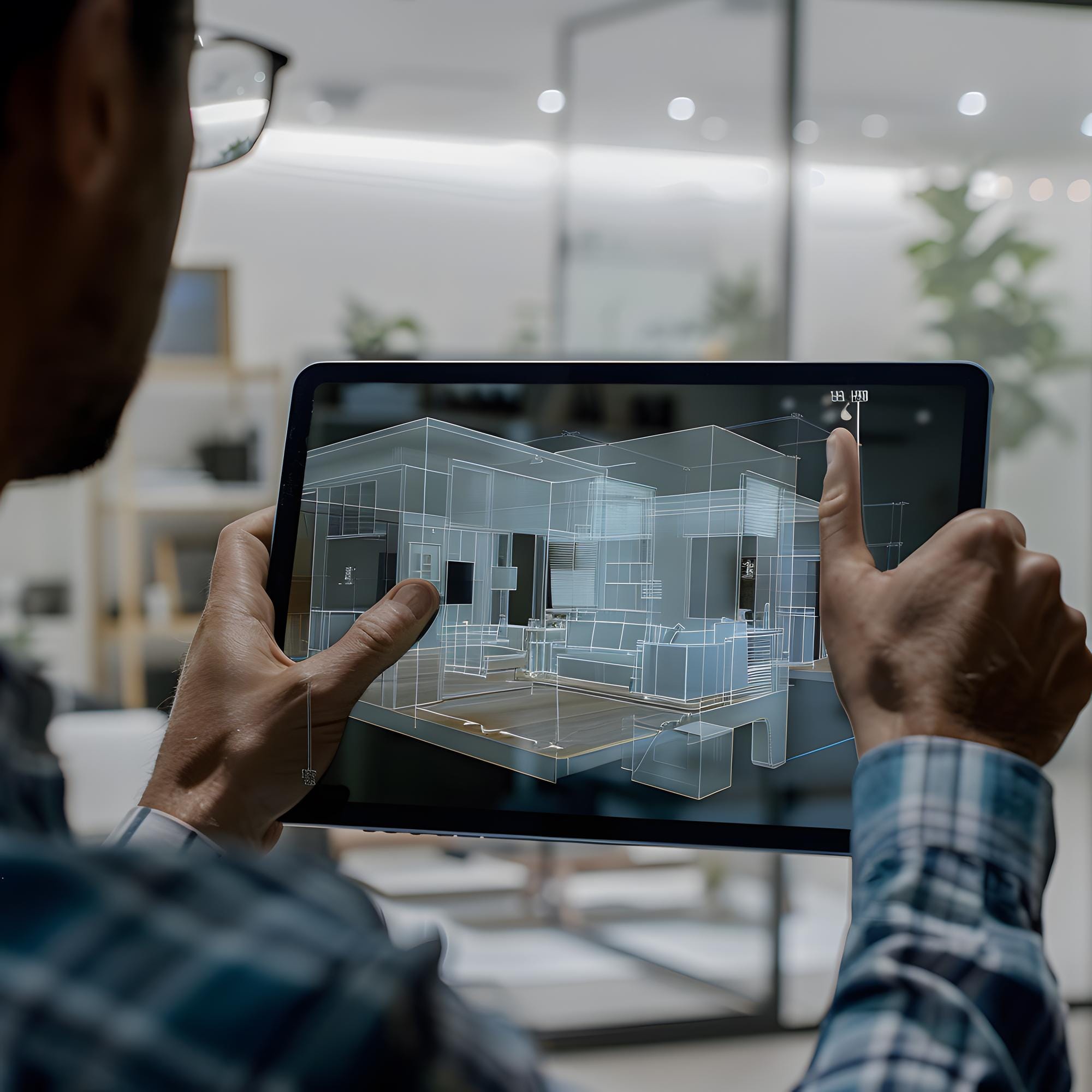
Artificial intelligence is no longer science fiction. It is here, quietly transforming the way we design, visualize, and build our spaces. And if you’re thinking about remodeling your home or investing in a real estate project, you need to understand how this revolution can completely change your experience.
The Quiet AI Revolution in Architecture
Five years ago, when a client came to us with a vague idea of how they wanted their home, we had to make sketches, 2D presentations, 3ds layout, and ask them to imagine the final result. Today, in 2026, it is different. Artificial intelligence helps the architect present the project before a single wall is demolished.
It’s not just a matter of technology for technology’s sake. It’s about democratizing access to quality design, reducing costly errors, and most importantly, ensuring that the end result is exactly what you envisioned.
How AI Is Transforming the Design Process
Concept Generation in Minutes
In the past, an architect would spend weeks developing concepts and hours rendering scenes. Today, AI can generate dozens of different concepts in hours, respecting the parameters we have defined: style, budget, functionality, sustainability.
This does not mean that the human architect has become obsolete. On the contrary. The architect now has more time to do what he does best: think strategically, understand the client’s emotions, and refine the ideas that the AI has generated. It is a partnership, not a replacement.
Space Analysis and Optimization
The CW uses AI to check if thoughtful layout choices can work and to help render the image. Be careful: the drawing measurements generated by AIs can become mismatched or dysfunctional in real life.
It is worth remembering that, on the CW Arquitetura (www.cwarquitetura.pt) website, there are no AI-generated photos — only real photos of our projects. It is sometimes possible to confuse AI-generated images with real photos, so we make a point of this distinction.
Realistic Visualizations Before Construction
This is the great differential. You’re no longer looking at 2D floor plans or generic renders. You’re seeing realistic frames of your future space, under different light conditions, at different times of the year.
Picture this: you can see how sunlight enters your living room in July at 4 p.m. You can see how artificial lighting works at night. You can virtually walk through your new apartment before any work begins.
This eliminates unpleasant surprises. Customers who feared that a chosen color was too dark can see it in practice. Investors who wanted to validate the potential of a property have visual proof before signing any contract.
The Role of the Architect in 2026: Human + Machine
Here’s the truth that many fear: yes, AI can do a lot. But what she can’t do is understand the history of her space.
A human architect asks, “Do you work from home? Do you have small children? Do you have friends over often? What is your biggest regret in the previous house?” These answers are not data that AI can process on its own. They require empathy, experience, and intuition.
The future of architecture in 2026 is this: AI providing efficiency, accuracy, and speed, while the architect provides creativity, strategy, and humanity.
Efficiency and Precision in Design
AI can suggest dimensions and positions with the appearance of precision, but some errors only appear for those who have study and experience in architecture. In a kitchen, for example, an appliance can technically be in the right place according to the design and, in practice, hinder the opening of another cabinet or the flow of those who cook. The ergonomics of the space — the distance between the countertop and the stove, the height of a cabinet, the angle of circulation — is something that only an attentive professional eye can safely evaluate.
Also, a project doesn’t end at the drawing. Monitoring with the contractor during the work makes all the difference: it is at this moment that small adjustments are made, unforeseen events are resolved and the project is adapted to the reality of the property. An AI does not visit the work, does not talk to the contractor and cannot follow up or make the adjustments that a real execution always requires.
Why AI Matters
Artificial intelligence is not just a technical tool. It is a creative partner that expands the possibilities of what is possible. Allows you to explore options that you would never have considered. Reduces costly errors. It ensures that the end result is exactly what you imagined.
The Future Has Arrived
Artificial intelligence is already a reality in interior design — and ignoring it would be a mistake. But using AI on its own, without the experience of an architect to validate what it suggests, also comes at a cost: measures that don’t work in practice, compromised ergonomics, or a project that looks ready on paper but doesn’t survive contact with the work.
At CW Arquitetura, we use AI as an additional tool — to explore ideas faster and better visualize the result — but it is the human eye that ensures that the project really works: that the kitchen is ergonomic, that the budget is realistic, and that the work is monitored from start to finish. It’s this combination, not technology alone, that transforms a beautiful drawing into a space that works in your real life.
Conclusion: The Future is Now
AI is not going to replace architects. It will free architects to do what they do best: create spaces that transform lives. If you want to experience the future of architecture, the time is now.
Schedule a consultation and find out how CW can transform your space. Contact Us