


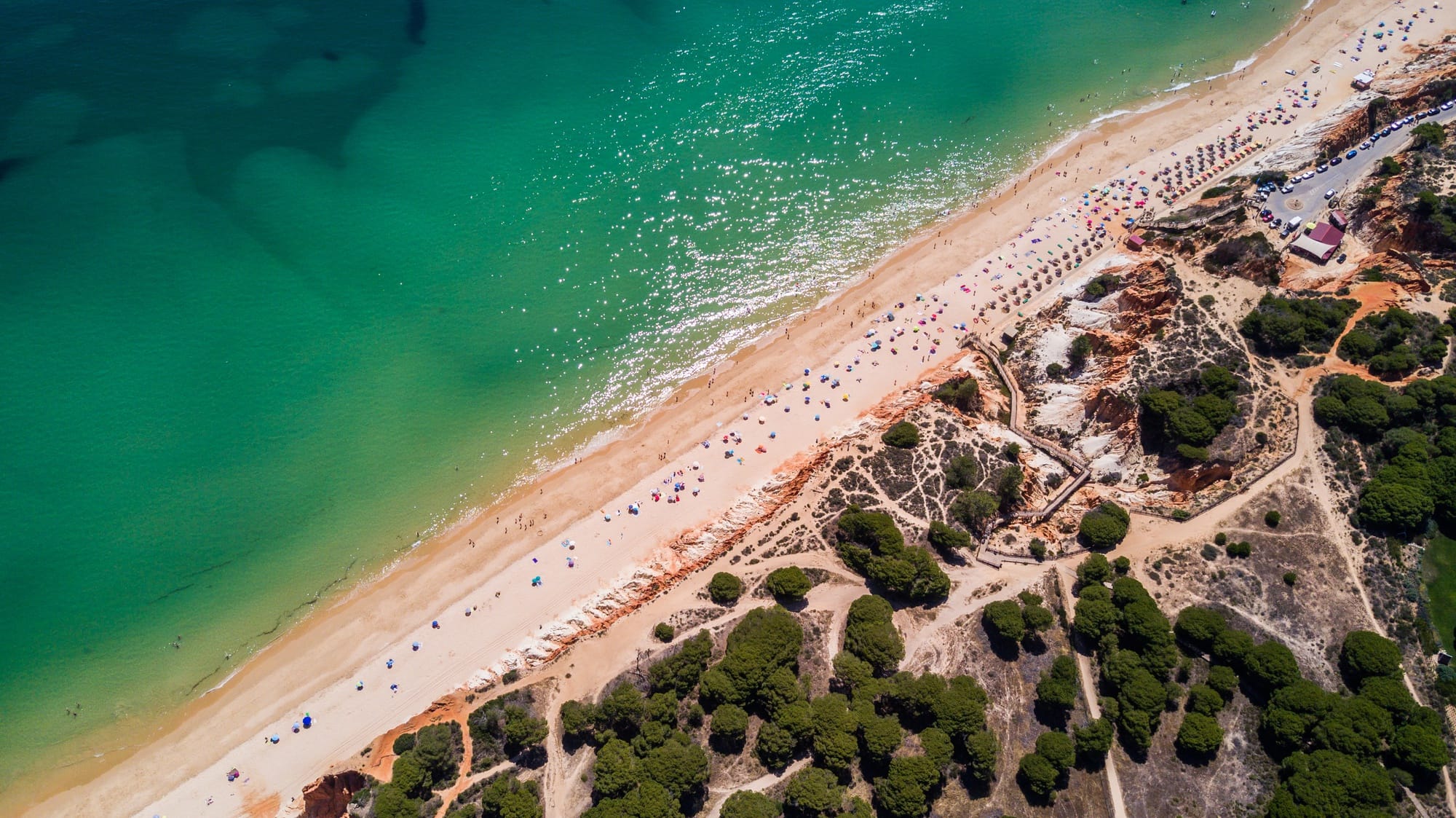
Few regions of Portugal have had, in recent years, as much influence on the imagination of decoration and architecture as Comporta and the Alentejo that surrounds it. The so-called “Comporta style” has become internationally synonymous with relaxed elegance, while the interior Alentejo continues to offer something rarer: space, silence and a vernacular architecture that has crossed centuries practically unchanged.
For those looking for a second home, a rural tourism project or a change of life to the countryside, understanding the differences and similarities between these two realities — the sandy coast of Comporta and the Alentejo plain — helps to decide where and how to build or decorate.
The Comporta style: simplicity that has become a global reference
Comporta was born architecturally from the humble fishermen’s huts and rice paddies of the region, built in wood with thatched roofs. It was this rustic simplicity that, reinterpreted in recent decades by architects and owners with contemporary sensibilities, gave rise to a style that is now replicated in decoration magazines around the world.
The result is a minimalist yet warm aesthetic: exposed natural wood, thatch or materials that evoke it, soft palettes — whites, beiges, greys, soft blues and greens — and large openings that erase the boundary between interior and exterior. Handcrafted ceramics, wicker basketry, linen and cotton complete interiors that favour natural textures over decorative excess.
- The landmark architecture combines wood and thatch, inherited from traditional fishermen’s huts and rice paddies.
- The color palette is neutral and muted, inspired by the landscape of dunes, pine forest, and rice paddies.
- Natural materials and local craftsmanship replace decorative excess in favor of understated sophistication.
The resorts and hotels that helped design Comporta
Much of Comporta’s international fame is due to a generation of hotels that translated local style into luxury hospitality. Among the best known are Spatia Comporta and Independente Comporta, both in Bicas, Casas de Arroz, in Possanco, and Casas na Areia, in Brejos da Carregueira — one of the first projects to show the world the reinterpreted thatched house, with a sandy floor inside.
Three names stand out, however, as the most exclusive in the region:
- Sublime Comporta — considered the reference resort in Comporta, integrated in the pine forest and with private villas, spa and several restaurants. In 2026 it relaunched its villas and is preparing the opening of Sublime Sand, designed for families.
- Quinta da Comporta — in Carvalhal, overlooking the rice paddies and a strong wellness aspect. It was acquired in 2026 by the French group Experimental, which will reposition it as Experimental Comporta.
- Vermelho — in Melides, about 20 minutes from Comporta, is the hotel designed by Christian Louboutin, a member of Relais & Châteaux, with an exuberant décor that contrasts with the minimalism of the region. It already has a second project planned, Vermelho Lagoa.
And the offer continues to grow: the Ando Living Comporta House, with 16 villas, is one of the most recent openings, and the Six Senses, integrated in the Pinheirinho Comporta development, is scheduled for 2028.
The surroundings of Comporta: far beyond the beach
Comporta is, in fact, the centre of a set of small villages and very different landscapes, between the Sado estuary and the Atlantic coast. Each one has its own character:
- Carvalhal, Pego and Brejos da Carregueira — villages scattered between pine forest and rice paddies, where many of the most sought-after holiday homes and well-known beach restaurants are concentrated. Pego beach is one of the most popular in the area.
- Torre and Possanco — small towns surrounded by rice paddies, with an even more rural atmosphere.
- Carrasqueira — famous for its stilt pier, with wooden walkways on stilts that serve the estuary’s fishermen. It is one of the most photographed places in the region.
- Sado Estuary Nature Reserve — home to one of the few resident communities of bottlenose dolphins in Portugal, as well as birds such as flamingos and storks.
- Tróia — the peninsula to the north, with calm water beaches, Roman ruins and a ferry connection to Setúbal.
- Alcácer do Sal — a historic village overlooking the river Sado, with a castle and a very pleasant riverfront.
- Melides and Grândola — to the south, with the Melides lagoon and a new wave of luxury projects that extend the “Comporta effect” along the coast.
This diversity is part of the charm: in a few minutes you can go from the beach to the rice paddy, from the pine forest to the estuary — and each landscape calls for a slightly different architecture.
The inland Alentejo: Évora, Arraiolos and surroundings
Moving away from the coast, the inland Alentejo shows another face, made of plains, cork oak and holm oak forests, and whitewashed villages.
- Évora — a museum city classified as a World Heritage Site by UNESCO, with the Roman Temple, the Cathedral and the Chapel of Bones, all within walls. It will be European Capital of Culture in 2027, which is bringing new boutique hotels to the historic center.
- Arraiolos — known for the hand-embroidered carpets that bear its name, a centuries-old tradition, and for the circular castle that dominates the village.
- Surroundings — Montemor-o-Novo, with its castle; Estremoz and Vila Viçosa, marble lands; the Almendres Cromlech, one of the largest sets of menhirs in the Iberian Peninsula; and Monsaraz, over the Alqueva lake.
It is in this landscape that the hills and estates that define traditional Alentejo architecture are found.
The traditional Alentejo: whitewashed houses, estates and hills
The interior Alentejo has its own architectural language, shaped over centuries to respond to the intense heat of summer. The rural houses — the hills and estates — have thick walls of rammed earth or masonry, whitewashed to reflect the sun, with colored bars in ochre or blue marking the base and frames of the windows.
The windows are purposely small, and the kitchen traditionally assumes the role of the heart of the house, often with direct entry from the outside. Cylindrical or square chimneys and a single ground floor complete this vernacular design, designed to keep cool in summer and warm in winter without any mechanical system.
- The thick, whitewashed walls are the traditional architectural response to the heat of the Alentejo summer.
- The reduced windows and the careful orientation of the rooms keep the house cool without air conditioning.
- Many estates and hills remain isolated in the territory, preserving ancestral construction techniques.
The expansion of the real estate market
Comporta’s international success was quickly reflected in real estate. For decades, much of the territory belonged to Herdade da Comporta, which helped keep the region poorly built. The sale of its assets to new investors in 2019 paved the way for a new phase of low-density developments, with houses, hotels and golf integrated into the landscape.
Today, the region concentrates some of the most ambitious projects in the country:
- Pinheirinho Comporta, by VIC Properties, with about 400 hectares, residences, hotels — including the future Six Senses — and golf, with four-bedroom villas starting at around 5 million euros.
- CostaTerra Golf & Ocean Club, in Melides, a private condominium with a golf course by the sea.
- The projects born from the former Herdade da Comporta, which continue to develop in a phased manner.
The numbers follow this demand. According to the consultancy Athena Advisers, with data from Casafari, luxury properties in Comporta are already traded between €6,000 and €10,000/m², exceeding €15,000/m² in houses by the sea, with an appreciation of around 20% in the prime segment in the last five years — values that already place Comporta ahead of the Algarve in coastal luxury. Engel & Völkers also points to a 12% growth in the number of transactions in Alcácer do Sal in the last year.
The buyers are Portuguese and foreigners — especially the British and Americans — and are mainly looking for privacy, authenticity and low density. The other side of the coin is known: infrastructures and services still growing, and demanding construction rules in a sensitive territory, which make each project more complex.
Who is looking for this lifestyle
The profile of those who choose Comporta or Alentejo to live or have a second home is quite specific: they are looking for space, privacy and a slower relationship with time, in deliberate contrast to urban life. Many are second home owners, Portuguese and foreigners, who use the house for extended getaways and holiday periods; others opt for a more permanent change, associated with rural tourism, wine tourism or simply a new pace of life.
This movement also attracted investors who saw in the region an opportunity to recover vacant rural properties, respecting the original design but adapting it to current comfort standards — a balance that requires refined architectural sensitivity.
- Second homes and tourism are the main drivers of demand in the region.
- The typical profile values space, privacy and deceleration compared to urban life.
- The recovery of old estates requires a balance between traditional design and current comfort.
What to consider in an interior design in this region
Whether on the coast of Comporta or in the interior of Alentejo, the climate is the starting point of any serious project. In Comporta, the proximity to the sea and rice paddies brings humidity and sand, requiring resistant materials and good cross ventilation. In the interior Alentejo, the challenge is reversed: very hot and dry summers, with a wide temperature range, require effective insulation and well-thought-out shading, especially on west-facing facades.
In both cases, respecting the bioclimatic principles of traditional architecture — thick walls, careful solar orientation, natural ventilation — usually gives better results than relying only on mechanical air conditioning, in addition to preserving the architectural identity that makes this region so sought after.
Recovering an Alentejo farm or building from scratch in the spirit of Comporta are projects that require architectural sensitivity and careful coordination between design, furniture and work. Learn more about what we do at CW Arquitetura and how we accompany turnkey projects in this region.
Do you dream of a house in the spirit of Comporta or an Alentejo estate? Talk to CW Arquitetura and tell us about your project. Talk to CW Arquitetura.