


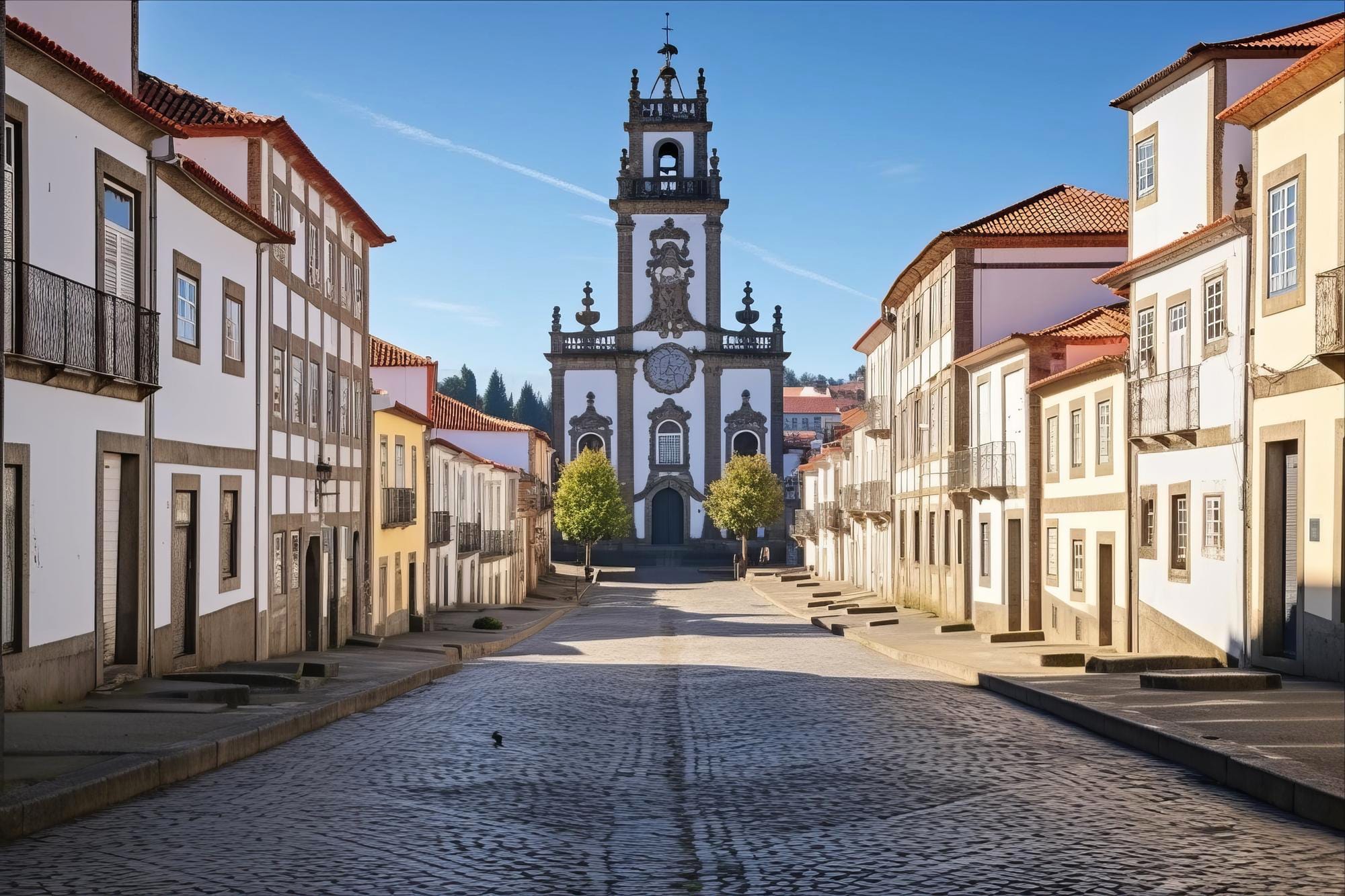
Not everyone who moves to Portugal wants to live in Lisbon or Porto. A growing share of expats, families and retirees are looking for just the opposite: smaller cities, with a more affordable cost of living, a slower pace and a very unique architectural and cultural identity. The north of Portugal offers just that.
Braga, Guimarães, Viana do Castelo and the Douro region concentrate an important part of the Portuguese historical heritage, very different landscapes and communities that maintain an authentic local life — and, in many cases, less than an hour from Porto.
Guimarães: the cradle of Portugal, World Heritage
Guimarães is often described as the cradle of Portuguese nationality, due to its association with the formation of the country in the twelfth century. Its historic center and the Leather Zone are UNESCO World Heritage Sites, recognized for the architectural continuity that can be observed there, with buildings ranging from the fifteenth to the nineteenth century built according to traditional Portuguese methods.
One of the most notable features of this architecture is the combination of granite ground floors with wooden partition upper floors — a technique so influential that it was carried over to the Portuguese colonies in Africa and the New World. Living in a historic center like this usually involves rehabilitating old buildings with specific conservation rules, but it results in houses with a unique character.
- The historic center of Guimarães has been a UNESCO World Heritage Site since 2001, with expansion to the Leather Zone in 2023.
- The combination of granite on the ground floor and partition on the upper floors is a local architectural mark.
- Rehabilitating in this area implies following conservation rules, but guarantees houses with a strong historical identity.
Surroundings: Montanha da Penha, with its cable car, Caldas das Taipas, Vizela and Fafe offer quieter alternatives with more space, just a few minutes from the center.
Distance to Porto: about 50 km, close to 45 minutes by car, with direct rail connection.
Braga: a young, dynamic city with a large Brazilian community
Braga combines a rich historic center, with baroque churches and an old urban layout, with a dynamic university and business life — largely thanks to the University of Minho — that makes it one of the youngest cities in the country.
It is also one of the Portuguese cities where the Brazilian community is most felt. According to AIMA, at the end of 2024 the municipality of Braga had about 28,500 foreign residents — more than double the approximately 12,700 registered in 2022. And already in 2021, according to data from the then SEF, Brazilians represented about 61% of foreigners in the municipality, the highest percentage among the district capitals in the country. For those arriving from Brazil, this translates into support networks, commerce, restaurants and associations that greatly facilitate adaptation.
The real estate offer combines old urban buildings and more recent construction in expanding neighborhoods, which gives more freedom to interior design than in fully classified areas.
Surroundings: Bom Jesus do Monte, a World Heritage Site since 2019, and Sameiro are at the gates of the city. Vila Verde, Póvoa de Lanhoso and Barcelos, with their famous weekly fair, offer more space and houses with land. And the Peneda-Gerês National Park is less than an hour away.
Distance to Porto: about 55 km, close to 45 minutes by motorway, and about 40 minutes to Francisco Sá Carneiro airport.
Viana do Castelo and Alto Minho
Further north, next to the mouth of the Lima River, Viana do Castelo combines Atlantic beach, mountain and a well-preserved historic center, with a much smaller and quieter stopover than Porto. It is a sought-after choice for those who want to live near the sea without the pace and price of the most touristy areas.
Surroundings: Ponte de Lima, one of the oldest villages in the country; Caminha and Vila Praia de Âncora, on the coast; Arcos de Valdevez and Serra d’Arga, for those looking for nature. And, next to the Minho River, Vila Nova de Cerveira — the “village of the arts”, known for its Biennial — with Spain on the other side of the river.
Distance to Porto: Viana is about 75 km away, close to an hour’s drive; Vila Nova de Cerveira, about 1h15 away.
The Douro: wine landscape World Heritage
The Alto Douro Wine Region has been a UNESCO World Heritage Site since 2001, recognized as an evolving cultural landscape built over more than two thousand years of viticulture. The terraced slopes along the river create one of the most recognizable landscapes in Portugal.
Living in the Douro usually means living associated with a farm or rural property, often linked to wine production, in an isolated environment of great beauty. It attracts above all those looking for a life project linked to the land — second home, rural tourism or quiet retirement — more than those who need urban infrastructure on a daily basis.
- The Alto Douro Wine Region has been a UNESCO World Heritage Site since 2001.
- The region is divided into three sub-regions: Baixo Corgo, Cima Corgo and Douro Superior.
- Living here is usually associated with rural properties and a rhythm of life linked to the vineyard.
Surroundings: Peso da Régua and Pinhão, in the heart of Port wine; Lamego, with the Sanctuary of Nossa Senhora dos Remédios; Vila Real, the reference city in the region; and Amarante, on the way to Porto.
Distance to Porto: Peso da Régua is about 1h15 by car; by train, the Douro line is a slower landscape journey.
Schools, hospitals and services: where it is easier to find
For families, the choice of city often depends on the school and hospital. In general, the closer to Porto and Braga, the more there is on offer:
- Porto and Greater Porto (including Gaia, Matosinhos and Maia) concentrate the largest offer: central public hospitals such as São João and Santo António, the IPO, several private hospitals, and most of the international schools in the region, with British, French, German and IB curricula.
- Braga has a public central hospital, private hospitals, the University of Minho and an international school with an IB curriculum, the Luso-International College of Braga (CLIB).
- Guimarães and Viana do Castelo have a public hospital, private clinics and higher education (University of Minho in Guimarães and the Polytechnic in Viana), with Porto and Braga as a complement for more specialized responses.
- In the Douro and in the interior, services are concentrated in the county seats, with Vila Real as the main hospital and university reference (UTAD). For international schools and more differentiated care, the reference continues to be Porto.
In practice, many families choose to live in a medium-sized city or its surroundings and use Porto for what is more specialized — something that the good connections by highway and train make simple.
Cost of living and profile of those who choose these regions
One of the most cited reasons for choosing these cities over Lisbon is the more affordable cost of living, both in buying a house and in everyday life, without giving up quality of life or heritage. It attracts mainly Brazilian families and those of other nationalities, international retirees, professionals working remotely and those looking for authenticity and tranquility.
For this profile, the challenge is rarely finding a home. It is finding someone who can manage, often remotely, the entire process of rehabilitation, decoration and furniture — especially for those who still live abroad during the work.
CW Arquitetura in the North of Portugal
Although our studio is based in the Lisbon region, CW Arquitetura follows projects throughout the country — and the North is one of the regions where we have worked. We have already developed projects in Vila Nova de Gaia, Porto, Braga and Vila Nova de Cerveira, from the architectural and interior design to the purchase of furniture and the coordination of the work.
Whether in Guimarães, Braga, Viana do Castelo, the Douro or Greater Porto, we follow the complete process for those who choose to live in the North. Learn more about what we do at CW Arquitetura.
Are you considering moving to the north of Portugal? Talk to CW Arquitetura and tell us about your project. Talk to CW Arquitetura.
Not everyone who moves to Portugal wants to live in Lisbon or Porto. A growing share of expats, families and retirees are looking for just the opposite: smaller cities, with a more affordable cost of living, a slower pace and a very unique architectural and cultural identity. The north of Portugal offers just that.
Braga, Guimarães, Viana do Castelo and the Douro region concentrate an important part of the Portuguese historical heritage, very different landscapes and communities that maintain an authentic local life — and, in many cases, less than an hour from Porto.
Guimarães: the cradle of Portugal, World Heritage
Guimarães is often described as the cradle of Portuguese nationality, due to its association with the formation of the country in the twelfth century. Its historic center and the Leather Zone are UNESCO World Heritage Sites, recognized for the architectural continuity that can be observed there, with buildings ranging from the fifteenth to the nineteenth century built according to traditional Portuguese methods.
One of the most notable features of this architecture is the combination of granite ground floors with wooden partition upper floors — a technique so influential that it was carried over to the Portuguese colonies in Africa and the New World. Living in a historic center like this usually involves rehabilitating old buildings with specific conservation rules, but it results in houses with a unique character.
- The historic center of Guimarães has been a UNESCO World Heritage Site since 2001, with expansion to the Leather Zone in 2023.
- The combination of granite on the ground floor and partition on the upper floors is a local architectural mark.