


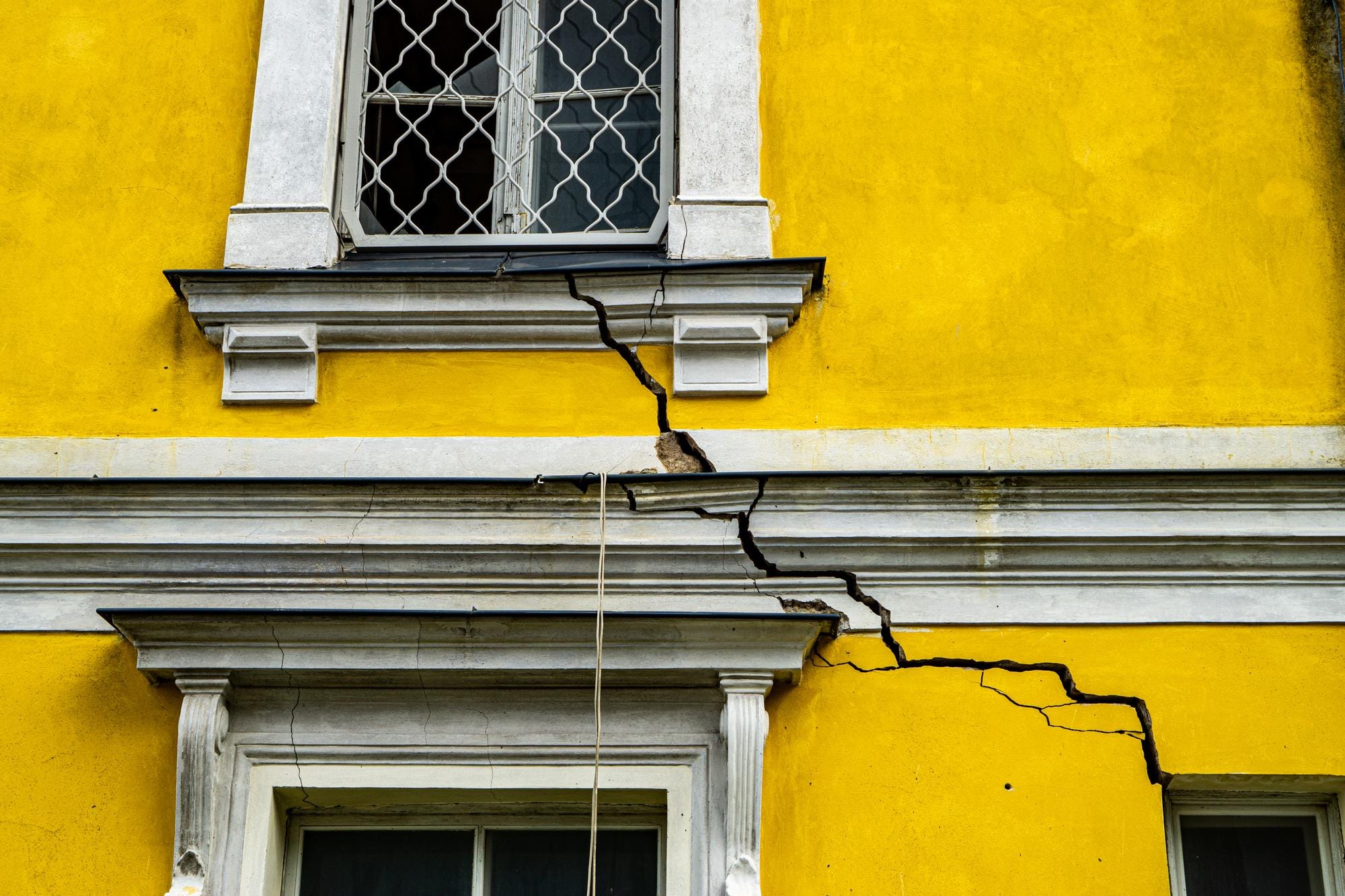
Portugal, and Lisbon in particular, has an old and well-documented relationship with earthquakes. The earthquake of 1755 marked the city in such a way that one can still see today, hidden within the walls of many Pombaline buildings, one of the most innovative anti-seismic construction solutions of its time. But anti-seismic construction did not stop in the eighteenth century: Portuguese legislation evolved over the decades, and the way a building withstands an earthquake depends, to a large extent, on when and according to what rules it was built.
For those who are buying a property in Portugal, especially in an older building, or are planning a refurbishment with structural changes, understanding this evolution helps to ask the right questions and to know what is worth checking before moving forward.
1755 and the Pombaline cage: one of the first anti-seismic solutions in the world
The great earthquake of November 1, 1755, followed by a tsunami and a fire that lasted for days, destroyed much of Lisbon and dramatically revealed the fragility of the masonry constructions of the time. In the reconstruction of the city, under the guidance of the Marquis of Pombal, the builders developed the so-called Pombaline cage: a three-dimensional wooden structure, assembled as a kind of flexible skeleton, embedded within the masonry walls of the buildings.
The idea was simple and ingenious: wood, lighter and more deformable than stone, absorbed part of the energy of seismic movement instead of simply fracturing, while the exterior masonry maintained fire protection and the aesthetic characteristics of the time. It is considered, by many engineering historians, to be one of the first structured anti-seismic solutions in the history of European construction — decades before there was any formal regulation on the subject.
From the first seismic regulation to the RSA of 1983
It was only in the twentieth century that Portugal began to have formal technical regulations on the action of earthquakes in the calculation of structures. The first modern regulation in this field dates back to 1958, requiring for the first time that seismic calculation be explicitly considered in the design of new buildings.
This basis was substantially revised and strengthened in 1983, with the publication of the Regulation on Safety and Actions for Building and Bridge Structures, known in the sector as RSA (Decree-Law No. 235/83, of 31 May). The RSA defined, more rigorously than before, the seismic action criteria to be considered in the design of structures, and was the main reference for the structural calculation of buildings in Portugal for about four decades.
The transition to Eurocode 8
Eurocode 8, the European standard dedicated to the design of structures for earthquake resistance, began to be worked on in Portugal in the 2000s, with the publication of the national version NP EN 1998-1 and the respective National Annex, which adapts the general European parameters to the specific seismic reality of the Portuguese territory.
The official and mandatory adoption of the Structural Eurocodes, including Eurocode 8, for building structure projects in Portugal was formalized by Normative Order No. 21/2019, published on September 17, 2019. This order established a transition period of three years, during which it was still possible to submit projects based on the old RSA. At the end of this period, on September 17, 2022, Eurocode 8 became the mandatory and exclusive reference for the seismic calculation of new structures in Portugal.
In practice, this means that a building licensed after 2022 was mandatorily sized according to more demanding and up-to-date seismic criteria than a building licensed, for example, in 2015 or 1990 — and the latter, in turn, followed different rules from a building before 1983 or 1958.
What this means in practice for those who buy or remodel
The age of the building is, therefore, one of the first data to check before buying a property in Portugal, especially in cities with more relevant seismic risk such as Lisbon, the Algarve or the Azores. A building prior to 1958 did not have any formal seismic calculation in its original construction; a building between 1958 and 1983 followed rules already outdated by current knowledge; and a building between 1983 and 2022 was dimensioned according to the RSA, which is still considered technically valid today but less demanding than Eurocode 8 in several aspects.
This does not mean that an old building is necessarily unsafe — many have been reinforced over the years, and the Pombaline cage, for example, continues to be recognized as a solution with good seismic behavior. But it does mean that, when evaluating an old property, it makes sense to ask if there has been any structural reinforcement intervention and, whenever the planned remodeling involves relevant structural changes — opening gaps in resistant walls, removing columns, changing slabs — ensuring that there is a stability project prepared by a competent engineer. Portuguese legislation has even provided, since 2019, specific criteria that require the evaluation and possible seismic reinforcement in larger rehabilitations, namely when the intervention represents a significant part of the area or construction value of the building.
- Check the year of construction of the building and, if possible, the year of the last licensing project.
- Ask if there has been any structural or seismic reinforcement work throughout the life of the building.
- In any work with structural changes, require a stability project signed by a civil engineer.
- Consider that only a small part of the properties in Portugal have insurance against seismic risk, something to consider as an owner.
Whenever a CW Arquitetura remodeling project involves changes to the structure of a property, we coordinate this technical part with specialized engineers, so that the creativity of the design never compromises the safety of the building. Learn more about what we do at CW Arquitetura.
Are you thinking of buying or remodeling an old property in Portugal and want to understand what structural checks make sense? Talk to us. Talk to CW Arquitetura.